Methodological Overview & Pedagogical Purpose
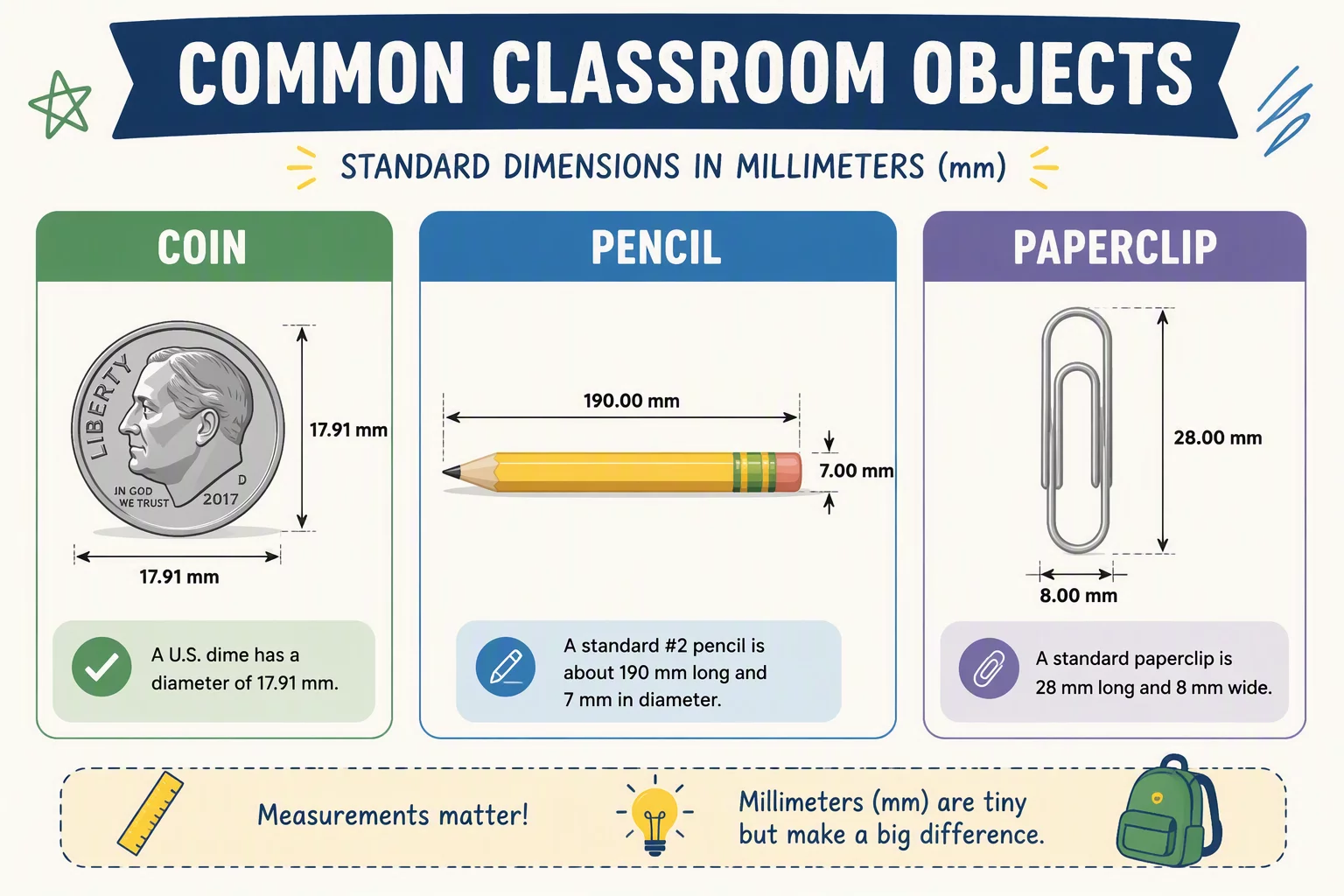
Establishing reliable real-world benchmarks forms the cornerstone of dimensional reasoning in introductory 3D CAD modeling. Middle and high school students frequently encounter scale distortion when transitioning between the boundless virtual workspace of Tinkercad and physical manufactured prototypes. A digital cylinder on a computer screen lacks tactile weight, making it deceptively easy to design a pen holder with a 5 mm opening or an oversized 120 mm keychain. This database catalogs standardized dimensions for everyday classroom artifacts, providing students with immediate, verifiable reference points that calibrate their intuition before they commit filament to a 3D print bed.
Utilizing physical reference objects bridges the cognitive divide between abstract numerical measurements and tangible spatial geometry. When learners examine a standard AA battery, an index card, or a USB-A connector, they associate specific millimeter thresholds with familiar tactile boundaries. This methodological guide provides baseline dimensional ranges, recommended clearance envelopes, and structured classroom routines that transform random guesswork into disciplined dimensional inquiry.
Instructor Core Recommendation
Always require students to measure two physical samples with digital calipers before entering dimensions into CAD software. Manufacturing variances between brands mean that a wooden pencil can vary between 7.2 mm and 7.9 mm across flats, teaching learners why clearance tolerances matter in functional prototyping.
Dimensional Framework & Step-by-Step Instructions
Implementing the Reference Object Database in classroom instruction follows a systematic four-phase dimensional inquiry protocol:
- Physical Tactile Audit: Distribute standard reference objects—such as AA batteries, paper clips, standard sticky notes, and dice—to student pairs for hands-on inspection and multi-axis caliper readings.
- Data Cross-Referencing: Have students verify their measured heights, diameters, and corner radii against the standardized database values to identify measurement error or tool misalignment.
- Clearance Envelope Modeling: Guide students in calculating necessary fit tolerances (+0.4 mm for sliding fits, +0.15 mm for snug friction fits) before sketching digital boundary volumes in Tinkercad.
- Fit-Check Negative Subtraction: Direct learners to create a simplified negative solid of the reference object and perform a Boolean difference operation inside their custom fixture or container design.
By anchoring every design assignment to a documented reference item from this registry, educators eliminate ambiguous project requirements. Students develop an instinctive appreciation for millimeter precision, recognizing how minor discrepancies of half a millimeter determine whether an enclosure snaps cleanly into place or fails entirely during assembly.
Formative Assessment Rubric & Fit Verification
Evaluate student design accuracy and reference object integration using structured dimensional performance criteria:
- Benchmark Measurement Precision (40%): Accurate recording of outer diameter, total length, and functional contact surfaces within a ±0.2 mm verification tolerance using digital vernier calipers.
- Tolerance Allowance Strategy (35%): Deliberate inclusion of intentional clearance offsets suited for FDM 3D printing rather than exact nominal zero-clearance modeling.
- CAD Verification & Fit Inspection (25%): Successful Boolean subtraction and physical test-fitting of the reference item into the 3D printed receptacle without warping or excessive play.
Continuous formative review throughout the design cycle reinforces iterative problem-solving skills. Encourage learners to maintain a dedicated engineering logbook where they record nominal dimensions alongside observed 3D print shrinkage, fostering authentic manufacturing awareness from the very first lesson.
No teaching notes or educator feedback yet. This could be your first comment!