Bridging Concrete Observation and Abstract Scale
ScaleSense Classroom Lab was founded on a simple observation: students frequently struggle when transitioning between everyday macro-level experiences and extreme scientific scales—from microscopic cellular structures to astronomical distances.
Our instructional modules and guided lab exercises equip teachers with tactile frameworks, proportional visualization models, and reproducible data sheets that turn abstract mathematical factors into tangible classroom discoveries.
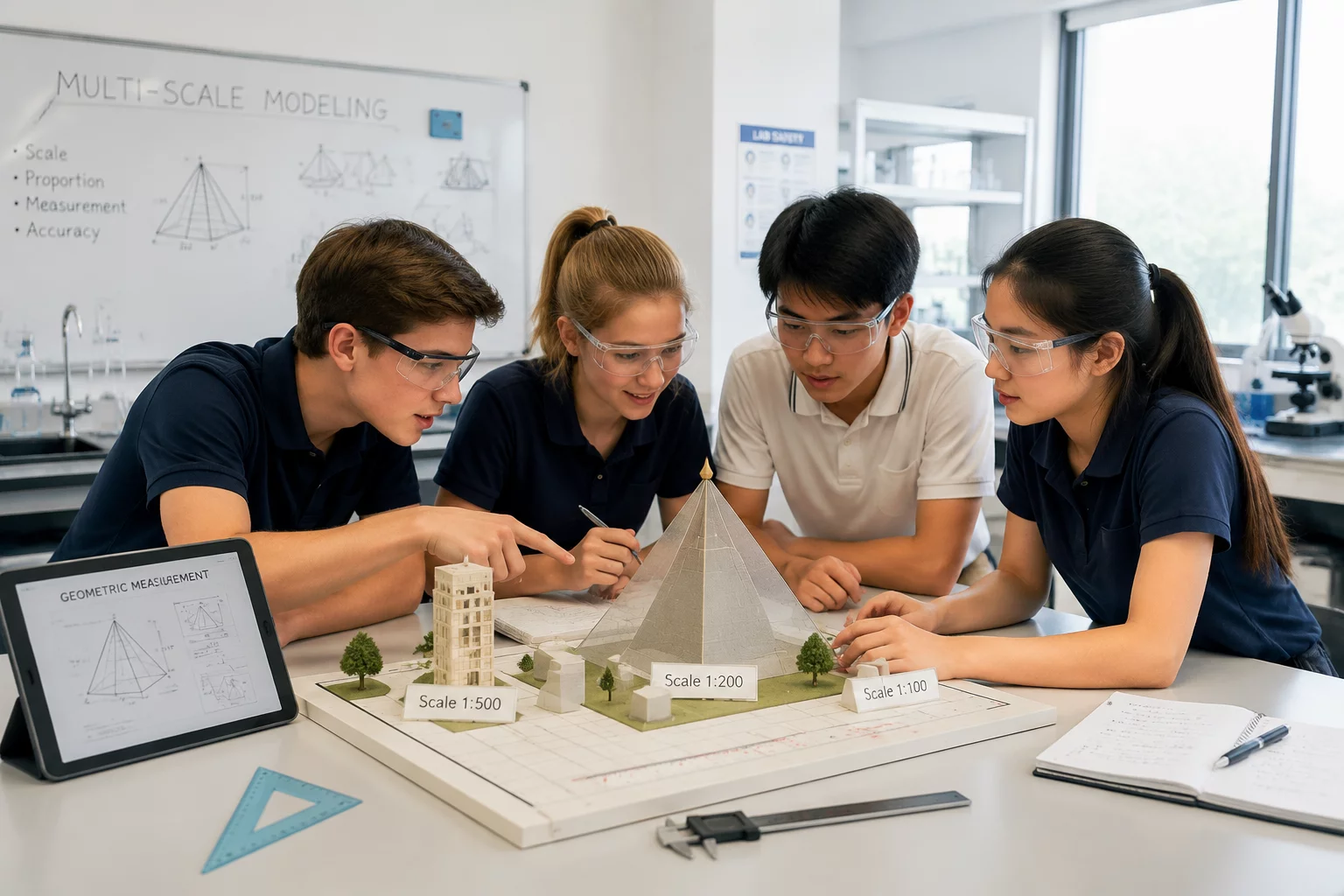
Empirical & Visual Mastery
Every lesson blends dimensional analysis with physical experiments, reinforcing spatial comprehension across physics, biology, chemistry, and geometric design.
Our Mission & Approach
Why ScaleSense Classroom Lab exists and how we serve educators
Mission
To eliminate the gap between abstract mathematical scale factors and the tangible objects students hold in their hands. We believe dimensional reasoning is a foundational literacy — as essential as reading or numeracy — for any learner engaging with 3D design, engineering, or physical science.
Approach
Every resource is built around a single principle: measure first, model second. Students begin with physical objects on their desk, record real dimensions, then translate those measurements into digital geometry — bridging the concrete and the abstract in every lesson.
Commitment
All curriculum materials remain open-access with no paywalls, account walls, or gated downloads. We publish under permissive educational licenses so that any teacher, in any classroom, can adapt and distribute our resources without administrative friction.
Explore Scientific Order of Magnitude
Test our interactive scale perspective selector to see how ScaleSense modular materials break down complex orders of magnitude into intuitive classroom comparisons.
Cell Walls and Macromolecules
Students construct scaled 3D wireframe models representing chloroplasts and lipid membranes, converting nanometer measurements into centimeter classroom equivalents.
Research-Backed Methodology
Our curriculum design is grounded in established STEM education research
Concrete-Representational-Abstract
We sequence every activity through the CRA instructional framework — physical manipulation first, visual representation second, symbolic math last — ensuring no learner is left behind at the abstraction step.
Iterative Measurement Cycles
Students measure, model, test, and remeasure — building metacognitive awareness of error margins and tolerance. Each cycle reinforces that real-world dimensions are never perfectly clean.
Collaborative Discourse
Lessons embed structured pair-and-share protocols where students defend their dimensional choices aloud — transforming measurement from a solitary task into a classroom conversation about engineering reasoning.
Authentic Assessment
Rubrics evaluate functional outcomes — does the holder fit the pencil? — rather than aesthetic decoration, aligning evaluation with real engineering criteria and building student confidence in measurable success.