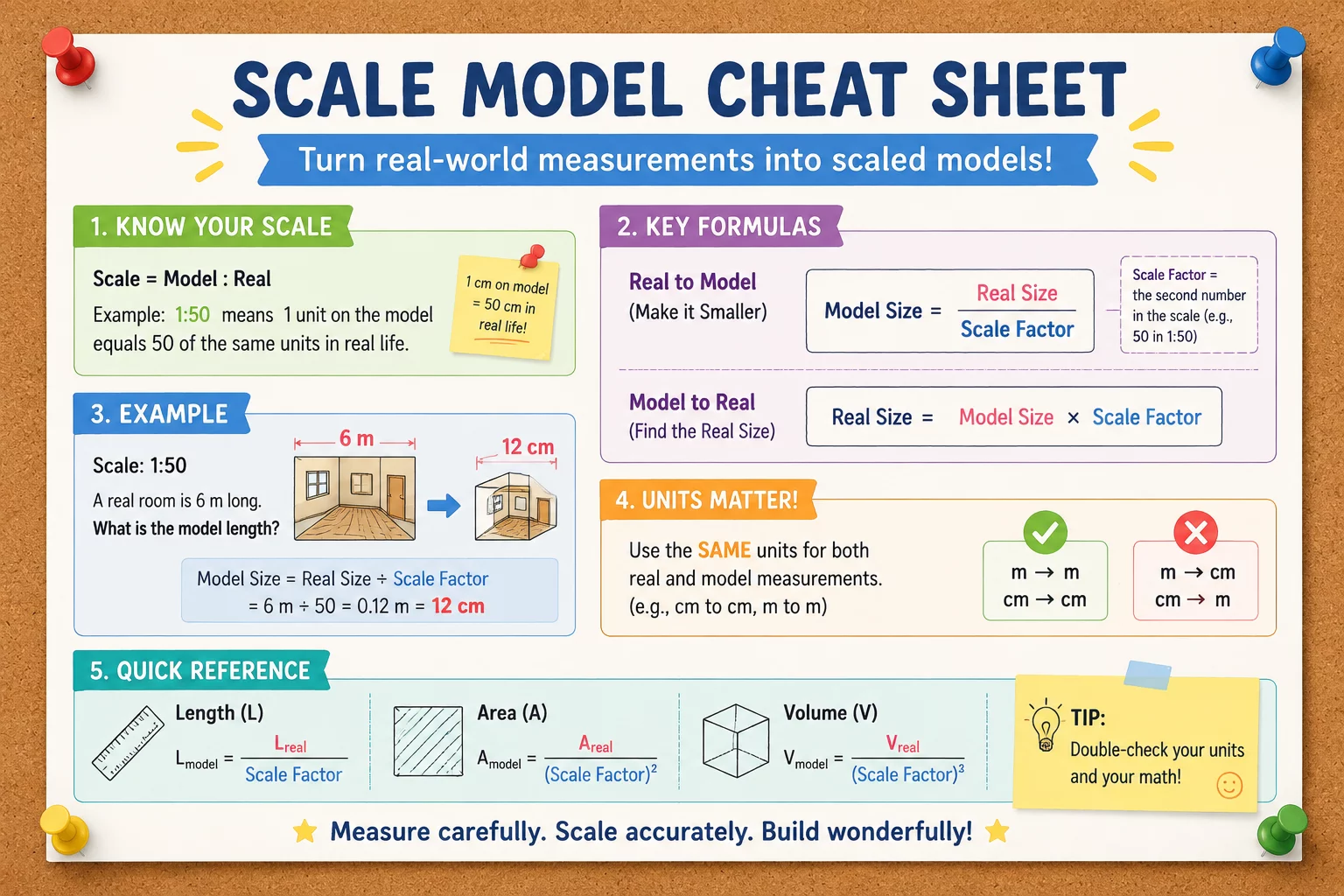
Methodological Overview & Pedagogical Purpose
Proportional reasoning presents one of the most persistent hurdles for students transitioning from two-dimensional drawing to three-dimensional digital fabrication. When learners modify a single dimension on a 3D digital model, they frequently expect surrounding properties like surface area and internal volume to adjust along identical linear ratios. This reference guide bridges abstract mathematical formulas with practical digital workspace workflows, giving students an immediate anchor for accurate physical conversions.
In introductory CAD environments, students easily drag uniform scale handles without calculating how cubic mass or print time expands exponentially. By keeping an accessible formula breakdown beside keyboards and digital caliper stations, middle and high school learners connect algebraic scaling rules directly to print bed parameters, material consumption, and part clearances.
Instructor Core Recommendation
Always have students solve for the linear scale factor (k = Target Size / Original Size) before touching any scale handles in Tinkercad or CAD software. Verify that they multiply all three primary axes (X, Y, Z) uniformly to avoid distorted wall thicknesses.
Dimensional Framework & Step-by-Step Instructions
To implement this reference sheet during design lab sessions, students proceed through a systematic calculation sequence before slicing their final 3D files:
- Measure the baseline physical target object using digital calipers to obtain reference dimensions in millimeters.
- Calculate the linear scale factor k by dividing the intended target model dimension by the initial measured reference length.
- Apply the surface area scaling multiplier (k squared) to estimate total exterior wall coverage and texture details accurately.
- Compute the volumetric expansion factor (k cubed) to anticipate changes in filament weight, infill material, and machine run duration.
Reviewing these calculations beforehand prevents failed assembly fits, excessive filament waste, and unexpectedly loose mechanical joints in multi-part prototyping tasks.
Formative Assessment Rubric & Fit Verification
Assess student scaling precision by evaluating three core criteria before sending design models to classroom 3D printers:
- Mathematical Integrity: The calculated scale factor accurately reflects measured real-world millimeter inputs across X, Y, and Z axes.
- Aspect Ratio Retention: The scaled digital body maintains identical proportional angles without non-uniform axis warping.
- Clearance Preservation: Internal holes and interlocking pins are adjusted independently to maintain functional tolerances (0.2 mm to 0.4 mm).
Consistent application of this rubric instills rigorous engineering habits and cultivates genuine spatial intuition in young designers.
Sarah Jenkins
STEM CoordinatorThis cheat sheet resolved the constant confusion my 8th graders had when scaling up miniature prototypes. Showing k-squared versus k-cubed on real 3D prints made the volume concept click immediately.