Methodological Overview & Pedagogical Purpose
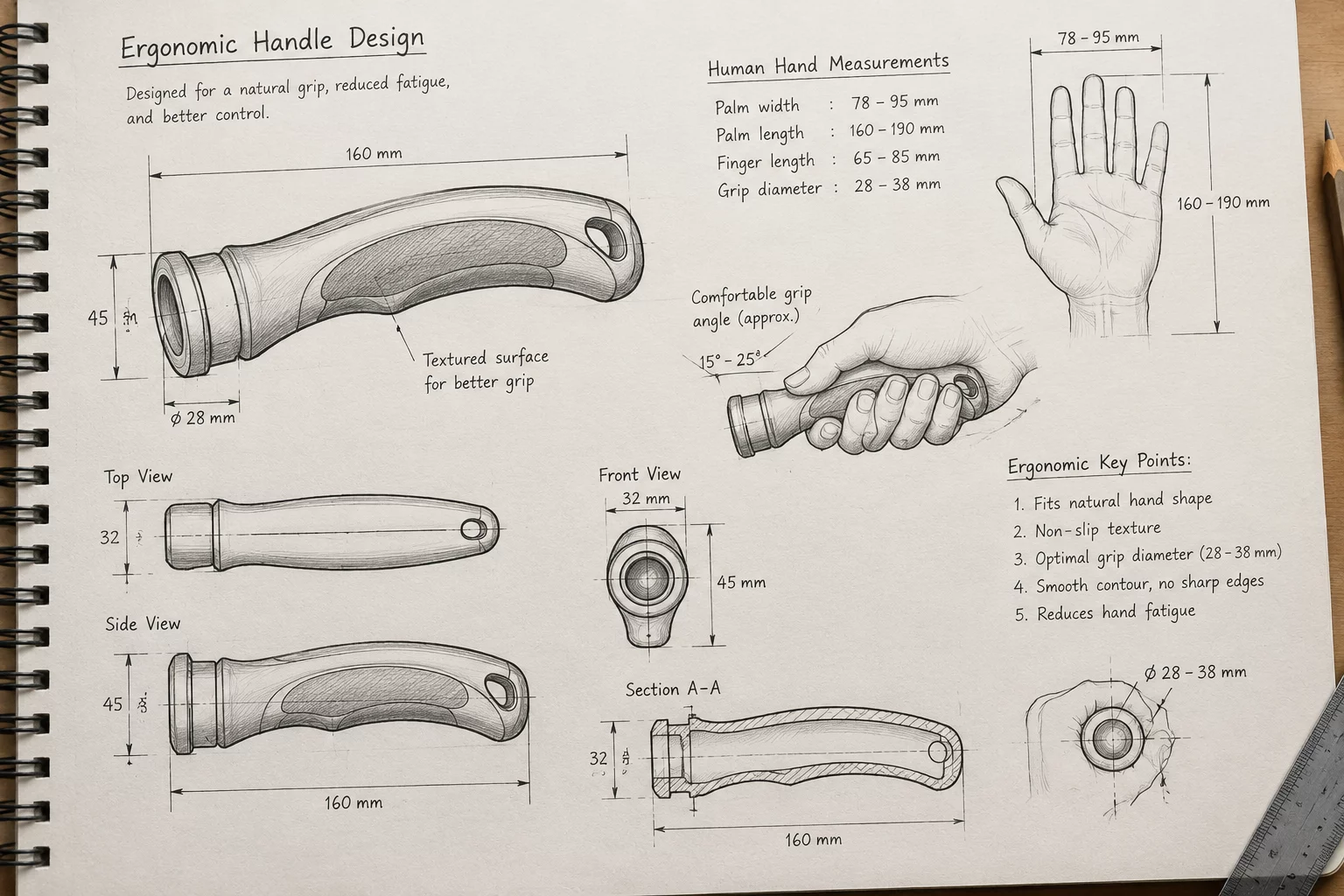
Industrial design frequently encounters the intersection of mechanical strength and anthropometric comfort. When students begin creating physical artifacts on digital workplanes, they frequently disregard the anatomical realities of the person using the finished object. This module establishes a direct educational bridge connecting biological human measurements with precise parametric CAD modeling in middle school STEM classrooms.
Students explore how palm breadth, finger curvature, and knuckle clearance dictate cross-sectional geometry. Instead of designing decorative forms that slip or pinch during practical use, learners collect biometric datasets from their own hands, calculate median clearance margins, and transfer these real-world values onto digital 3D coordinate planes.
Instructor Core Recommendation
Have students physically grip modeling clay or playdough before opening Tinkercad. Measuring the resulting finger indents with digital calipers provides immediate tactile evidence that human grip contours require subtle ellipsoidal curves rather than sharp rectangular blocks.
Dimensional Framework & Step-by-Step Instructions
A successful ergonomic handle relies on four critical spatial zones: gripping circumference, internal knuckle clearance, fillet radius, and load-bearing wall thickness. Guide students through this structured fabrication sequence:
- Record four distinct baseline measurements: hand breadth across knuckles (typically 65 mm to 85 mm for adolescents), index finger diameter (14 mm to 18 mm), closed grip inner circumference, and thumb reach radius.
- Add a minimum clearance allowance of 8 mm to 12 mm to the total inner opening height to ensure fingers slide freely without rubbing against adjoining fixture walls.
- Construct the main handle body using rounded rectangular prisms or lofted cylinders with a cross-sectional diameter between 22 mm and 28 mm to avoid hand fatigue during prolonged lifting.
- Apply consistent edge chamfers and minimum 3 mm fillets along all contacting perimeters to distribute contact pressure evenly across sensitive palm tissues.
Once students establish primary dimensions in software, they must verify cross-sectional thickness against standard FDM 3D printing infill parameters. Handle walls intended for manual pull force require at least four solid perimeter shells and twenty percent infill density to withstand torsion.
Formative Assessment Rubric & Fit Verification
Evaluate student models using a three-tier criterion focused on biometric accuracy, geometric stability, and functional ergonomics:
- Dimensional Compliance: Does the internal grip span allow full four-finger insertion without lateral compression or knuckle binding?
- Surface Ergonomics: Are all exterior gripping boundaries smoothed with fillets to prevent sharp edge pressure points during maximum grip torque?
- Printability and Structural Integrity: Is the component oriented on the print bed to ensure tensile loads run parallel to deposited filament layers rather than cleaving layer seams?
Integrating physical fit tests right after rapid slicing empowers learners to iterate proactively. When an unfilleted edge creates discomfort during testing, students quickly pinpoint the exact digital dimension requiring refinement and adjust their parameters accordingly.
Marcus Vance
Middle School STEM CoachOur 7th graders loved applying their own hand grip measurements before opening Tinkercad. Having them measure knuckle clearance with calipers completely prevented undersized, ungraspable prints!