Methodological Overview & Pedagogical Purpose
Novice designers frequently encounter a frustrating disconnect between digital CAD workplanes and real-world physical parts. When students construct parts on a digital canvas without an intuitive understanding of scale, they default to visual approximations. A cylinder on screen might appear perfectly sized next to another shape, yet upon physical manufacturing it turns out ten times larger or smaller than intended. The core objective of this methodological framework is to ground every digital transformation in conscious physical estimation.
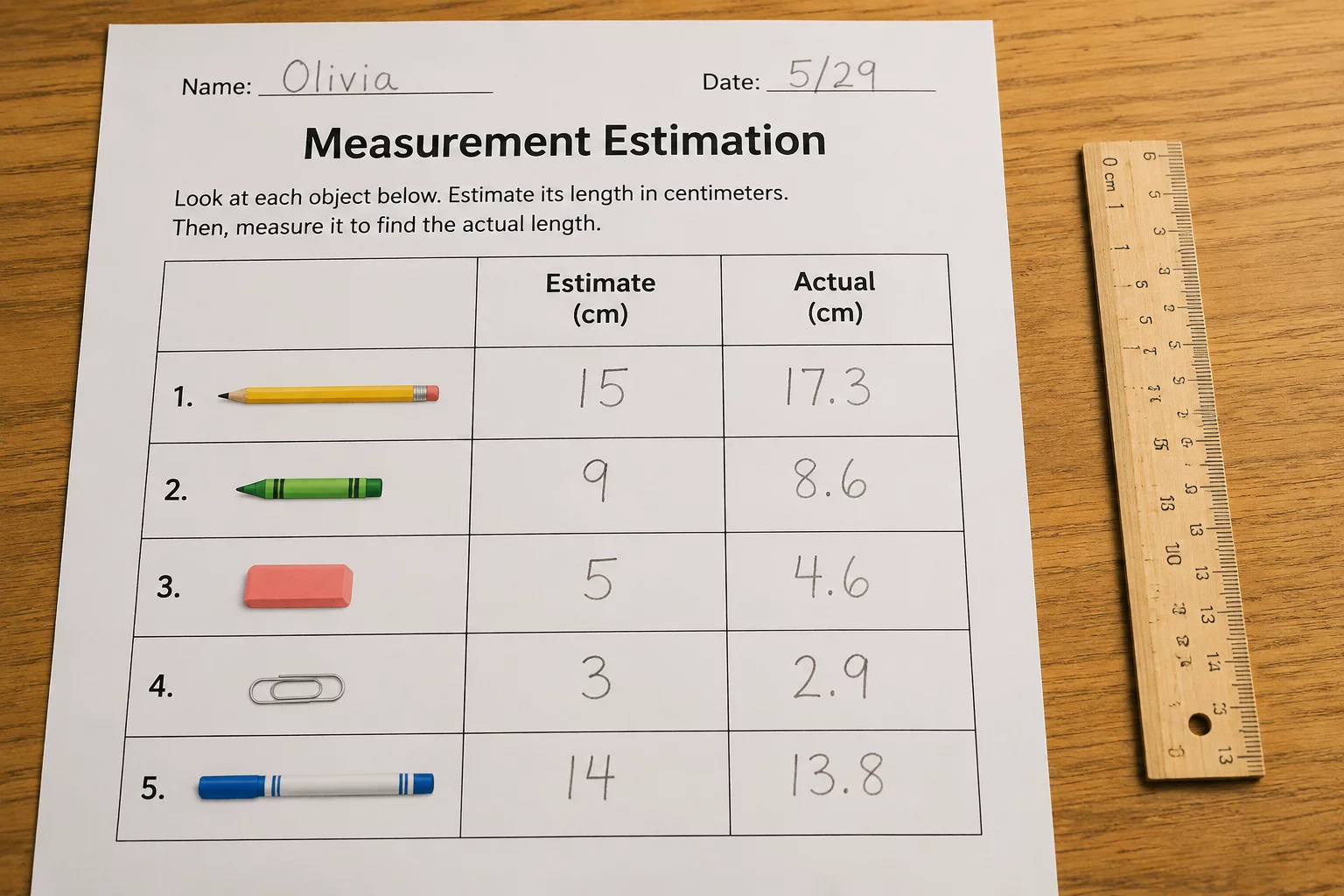
Requiring students to state and write down an explicit numerical hypothesis before using any physical measuring tool activates prior sensory memory. As students handle an everyday reference object like a standard eraser, battery, or USB flash drive, they must assign estimated values in millimeters across all three principal axes. The act of recording an estimation establishes a cognitive anchor. When they subsequently verify the dimensions with a vernier or digital caliper, the discrepancy between expectation and reality creates an immediate, highly effective feedback loop that recalibrates their spatial intuition.
Instructor Core Recommendation
Never permit students to open the 3D software workspace before they have completed the estimation and verification table on paper. Physical tactile engagement must always precede CAD geometric manipulation to prevent scale illusion.
Dimensional Framework & Step-by-Step Instructions
To integrate this method into your engineering design curriculum, follow this sequenced four-stage classroom routine:
- Phase 1: Tactile Observation — Students hold the selected target object with their hands without rulers or measuring devices, observing length, width, thickness, and curvature.
- Phase 2: Hypothesis Recording — Each learner logs their best estimate for X, Y, and Z dimensions directly into Column A of their laboratory worksheet in exact millimeters.
- Phase 3: Precision Caliper Verification — Students use digital or sliding vernier calipers to measure the true physical values to one-tenth of a millimeter and record them into Column B.
- Phase 4: Deviation Analysis & CAD Transfer — Learners calculate the percentage error between the two columns, reflect on which dimension was most distorted in their perception, and then input the verified dimensions into their Tinkercad model.
Through repeated cycles across varied object geometries—prismatic, cylindrical, and tapered—students quickly discover personal perception biases. Many learners consistently overestimate vertical height while underestimating wall thicknesses and depth clearances. Identifying these patterns early in the course drastically reduces failed 3D prints during subsequent design challenges.
Formative Assessment Rubric & Fit Verification
Evaluating spatial reasoning progress relies on tracking how quickly a student's estimation gap narrows over successive design iterations rather than penalizing initial inaccuracies.
- Estimation Precision Index: A student's initial unmeasured prediction lands within twenty percent of true caliper readings across length, width, and height.
- Proper Metrology Technique: The learner holds calipers perpendicular to measured features without overtightening or tilting the jaws during physical verification.
- CAD Dimensional Fidelity: The final digital object geometry in Tinkercad reflects the verified physical measurements within a tolerance threshold of plus or minus 0.3 mm.
When combined with physical fit tests—such as designing a cap, holder, or connector for the measured item—this methodology empowers learners to understand tolerances not as abstract mathematical rules, but as indispensable engineering safeguards for physical assembly.
Sarah Jenkins
Middle School STEM EducatorHaving students record their blind estimates before picking up calipers completely transformed our Tinkercad sessions. The error margin dropped dramatically within two weeks.