Methodological Overview & Pedagogical Purpose
Beginner CAD students naturally think in linear terms. When a student decides that a 20 mm calibration cube looks too small on the digital workplane, dragging the bounding box corners to 40 mm feels like a modest two-fold adjustment. In digital modeling viewports where infinite virtual space lacks physical weight or tactile feedback, this perceptual distortion happens constantly.
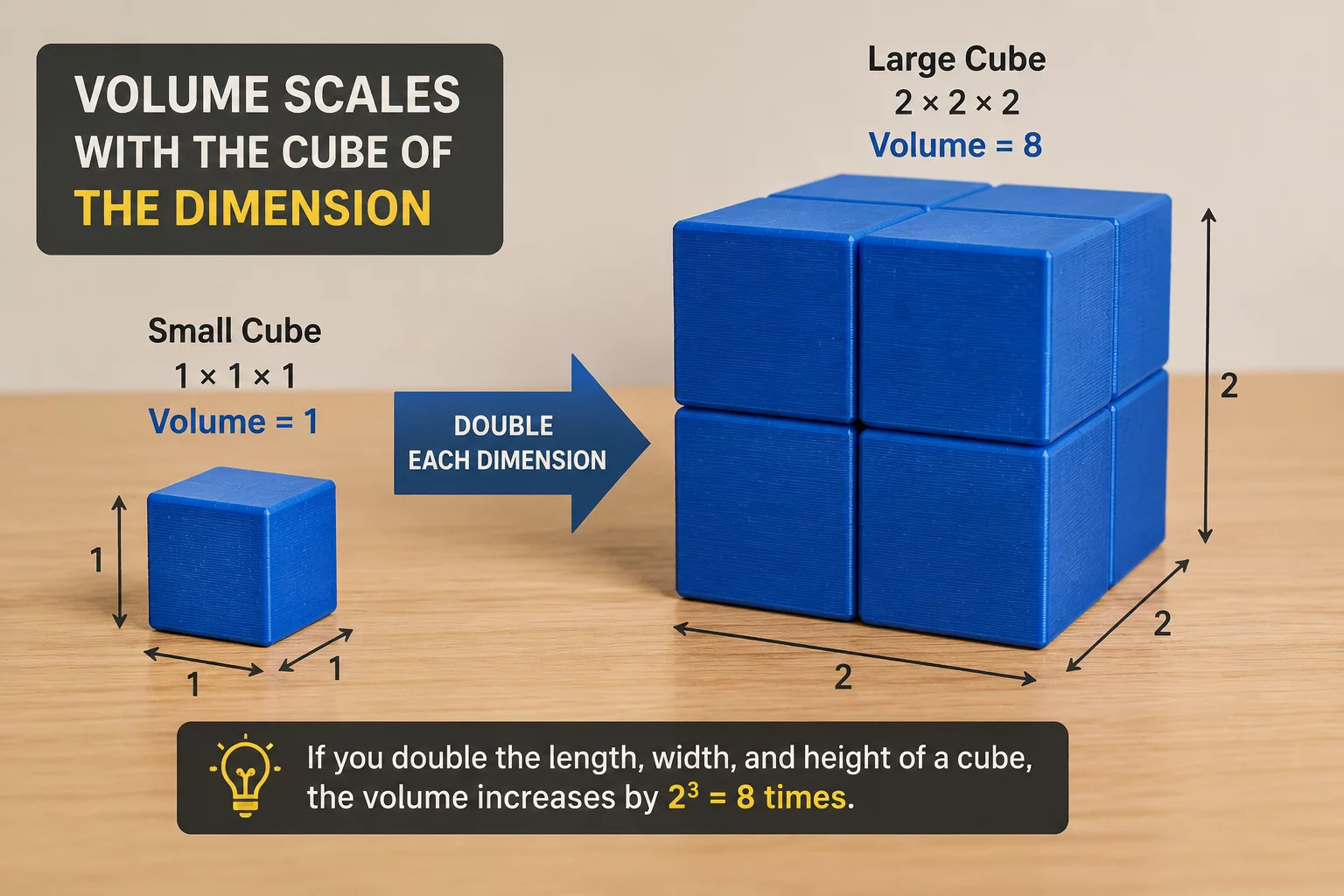
This methodological guide unpacks why scaling every orthogonal axis produces dramatic non-linear effects. While linear edge length doubles from scale factor k = 2, total boundary surface area scales quadricly (k² = 4), and internal spatial volume expands cubically (k³ = 8). In real manufacturing workflows, this cubic jump turns a thirty-minute 8-gram test print into a four-hour 64-gram sink of classroom filament.
Instructor Core Recommendation
Before allowing students to export scaled STL files to slicing software, require them to calculate both the anticipated surface area and volume on paper. Comparing their numerical estimations with actual slicer weight and duration predictions creates immediate conceptual clarity.
Dimensional Framework & Step-by-Step Instructions
To implement this learning sequence effectively in middle or early high school classrooms, structure the lesson across sequential inquiry steps:
- Construct a baseline unit cube measuring exactly 10 mm on each side in CAD, recording its baseline surface area (600 mm²) and enclosed volume (1,000 mm³).
- Duplicate the unit geometry and apply a uniform scale factor of 2.0, setting length, width, and height to 20 mm.
- Assemble eight original 10 mm unit cubes inside the CAD workspace to physically fill the 20 mm scaled boundary, proving visually that eight original volumes occupy the enlarged envelope.
- Import both solid models into a standard slicing tool, examining how filament usage grams and layer calculation times correspond precisely to volume and surface area growth.
Through this hands-on progression, students observe how mathematical proportions directly govern mechanical reality. They realize that scaling up a container or structural bracket quickly introduces thermal warping risks, bed adhesion challenges, and severe material waste.
Formative Assessment Rubric & Fit Verification
Evaluate student mastery of proportional growth principles through clear dimensional criteria and verbal explanations:
- Mathematical Explanation: The student correctly states that surface area multiplies by four while volume multiplies by eight whenever linear dimensions are doubled.
- Slicer Analysis: The learner demonstrates how infill percentage and perimeter shells alter mass distribution without changing the fundamental cubic outer boundaries.
- Practical Optimization: The student suggests selective scaling strategies, such as thickening only load-bearing walls rather than uniformly expanding the entire model.
Applying these criteria ensures that students develop intentional CAD habits, designing parts with precise functional clearances rather than relying on arbitrary uniform scaling.
Sarah Jenkins
STEM EducatorUsing eight physical 10mm cubes to assemble the 20mm cube on the front table was an absolute game changer. My students finally understood why their print queues were backing up whenever someone doubled their model size!