Methodological Overview & Pedagogical Purpose
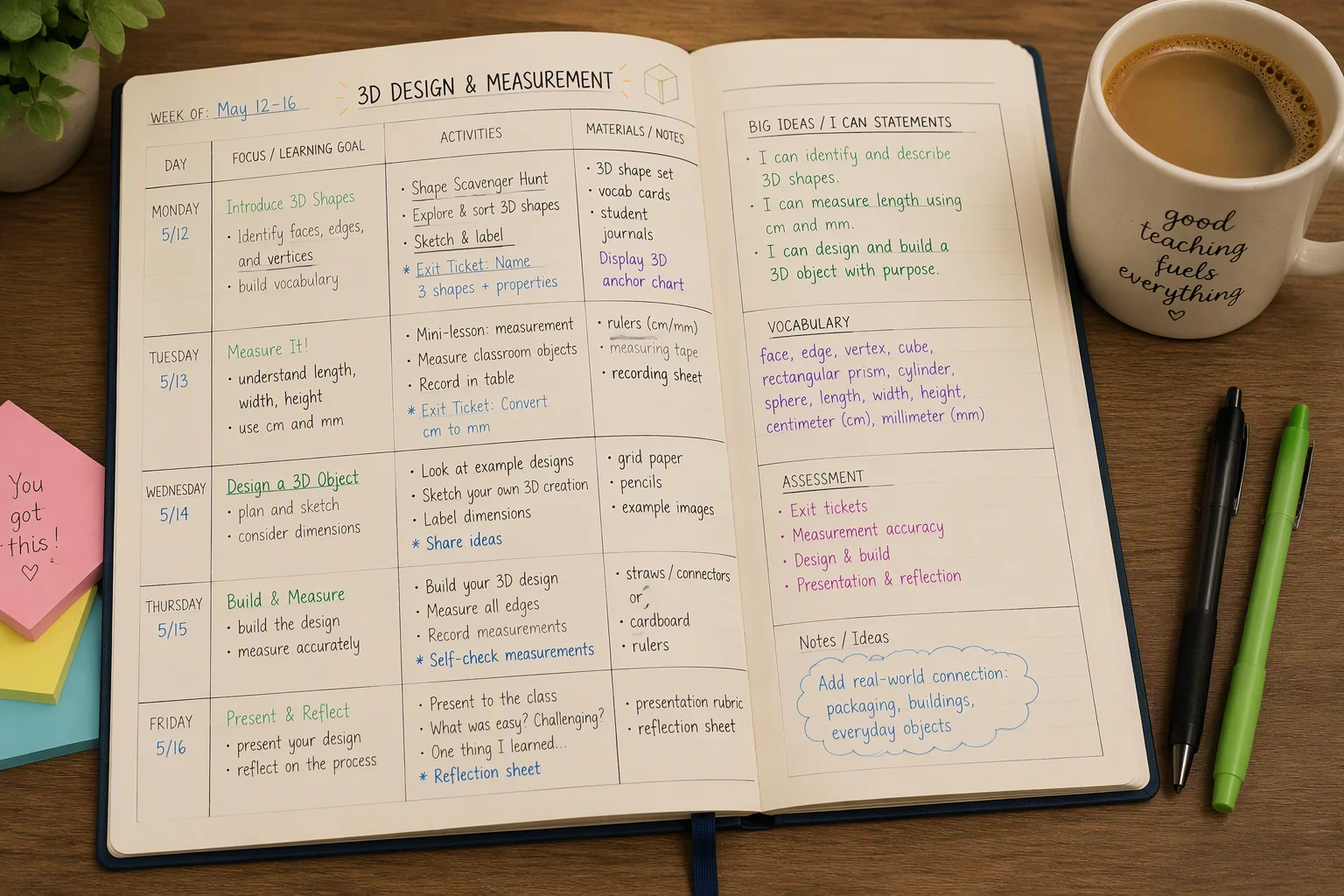
Structuring hands-on engineering units requires balance between open-ended exploration and strict dimensional constraints. This planner provides educators with a modular framework for pacing Tinkercad modeling, physical caliper measurements, and iterative 3D printing over a five to seven session module.
Students often struggle when transitioning from freeform artistic digital sculpting to precision parametric modeling. By establishing clear stage milestones, this guide helps teachers guide learners through estimation benchmarks, physical verification tests, and iterative clearance adjustments before printing.
Instructor Core Recommendation
Enforce physical caliper measurements before any student opens Tinkercad. Recording real-world dimensions on a paper review sheet prevents arbitrary digital scaling errors and saves classroom 3D printing filament.
Dimensional Framework & Step-by-Step Instructions
Organize your classroom schedule across distinct instructional stages to maximize machine availability and collaborative peer reviews:
- Session 1: Introduce physical measurement tools, caliper vernier scales, and standard reference item database entries.
- Session 2: Conduct estimation challenges where students record rough object sizes before verifying exact millimeter values.
- Session 3: Transition to Tinkercad to construct simple parametric shells using explicit digital dimension inputs instead of unconstrained drag handles.
- Session 4: Perform peer tolerance reviews using clearance gauge sheets, followed by test printing and fit verification.
Distribute print jobs strategically across small build batches. Have student teams review each other's .STL files using a pre-flight digital checklist before sending slices to the print queue.
Formative Assessment Rubric & Fit Verification
Assess student mastery based on functional mechanical accuracy rather than surface aesthetics alone:
- Measurement Accuracy: Recorded physical dimensions match actual vernier caliper readings within ±0.3 mm.
- Proportional Scaling: The digital model preserves required aspect ratios and designated wall thicknesses during scaling exercises.
- Clearance Consideration: The final physical prototype accounts for print nozzle expansion and fits the reference item cleanly.
Encourage students to document why initial test fits succeeded or failed. This reflective analysis builds critical troubleshooting skills and solidifies spatial awareness throughout the entire design curriculum.
No comments yet. This could be your first comment!