Classroom Scale & Dimension Objectives
Designing an isolated geometric shape inside computer modeling software often gives beginners a false sense of security. On a digital workplane, objects occupy clean theoretical boundaries with zero friction and perfect alignment. Once physical additive manufacturing or real-world assembly enters the equation, thermal shrinkage, layer deposition variations, and material expansion demand intentional clearances.
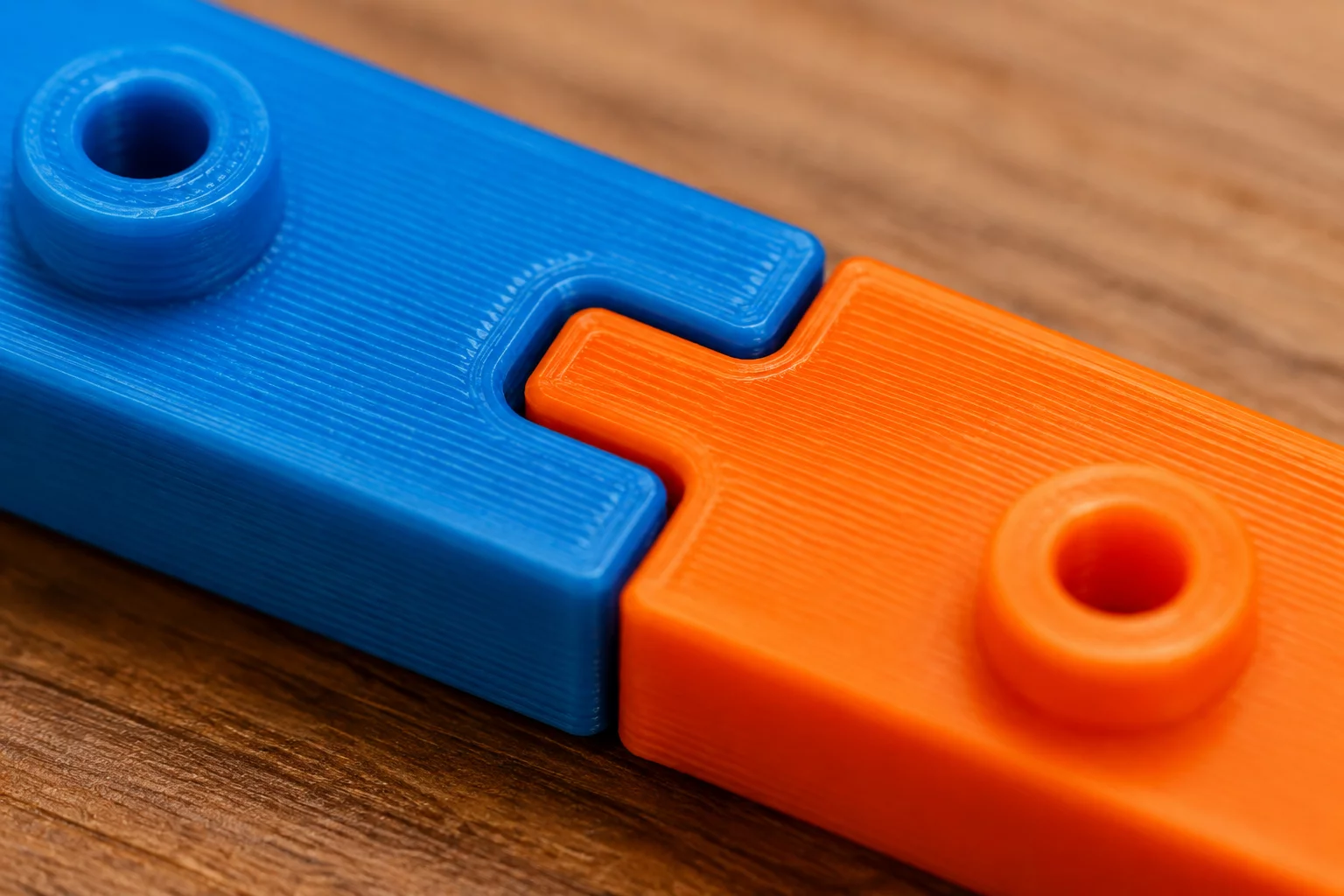
The Fit Challenge immerses middle-school and introductory STEM students in functional prototyping. Instead of creating decorative trinkets, learners design pairs of interlocking components—such as a cylinder peg and socket block, a sliding dovetail rail, or a nested cap. Through iterative testing, students observe how nominal dimensions differ from fabricated geometry, mastering the fundamentals of mechanical clearance.
Proportion & Measurement Rule
Nominal digital dimensions never equal fabricated physical clearances. Always allocate an intentional 0.3mm to 0.5mm offset on mating surfaces when designing sliding or press-fit connections for standard FDM classroom 3D printers.
Step-by-Step Educational Workflow
Implement the activity across three focused educational phases. Students start at their desks with physical measurement tools, transition to the Tinkercad grid to implement dimensional offsets, and conclude by evaluating physical fit using printed gauge blocks or modular test assemblies.
Stage 1: Physical Reference Measurement
Hand students physical sample pegs, dowels, or reference items alongside digital calipers. Have them record three distinct diameter readings along the object to identify surface irregularities and establish a baseline external boundary value.
Stage 2: Translating Values into Tinkercad
Instruct learners to create their host socket or sleeve inside Tinkercad. They must apply positive clearance offsets by enlarging the internal cavity by +0.4mm on all radial dimensions to prevent binding during physical insertion.
Stage 3: Testing Tolerances & Clearances
Compare test prints or virtual cross-sections using the transparent 'Hole' tool. Students evaluate whether their mating walls maintain adequate wall thickness while leaving sufficient void space for smooth friction-fit movement.
Formulas and Spatial Checks
Dimensional calculations in additive fabrication depend on understanding diameter versus radius offsets. When adjusting circular holes, learners must add double the radial clearance to the overall diameter parameter. For rectangular slots, clearance offsets must be applied along both the X-axis and Y-axis independently.
- Inner socket diameter = mating peg diameter + (2 × target clearance gap).
- Minimum surrounding wall thickness = at least 1.6mm (4 printer wall perimeters) to prevent splitting during insertion.
- Chamfer or bevel lead-in edges by 0.5mm to guide interlocking pieces smoothly into alignment.
Documenting fit trials in a lab journal instills authentic engineering reflection. When parts bind too tightly, students diagnose whether printer extrusion calibration or 3D modeling offsets caused the interference, fostering critical troubleshooting mindsets.
Sarah Jenkins
STEM EducatorRunning the Fit Challenge with 7th graders completely shifted their understanding of why millimeter measurements matter. Our students initially made exact 10mm holes for 10mm pegs and wondered why nothing fit until we introduced the 0.4mm clearance rule!